
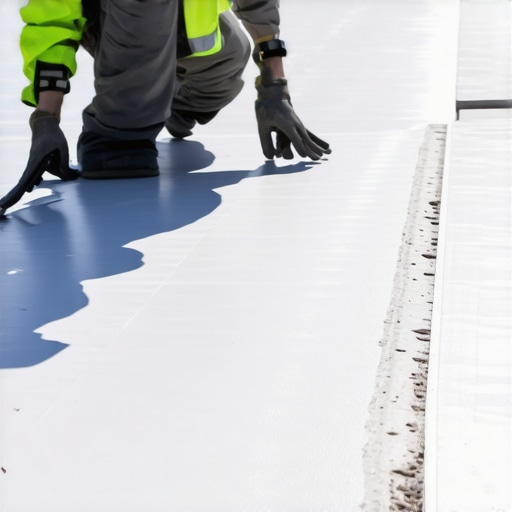
The Ghost in the Server Room: Why Your ‘Perfect’ White Roof is Leaking
I’ve spent twenty-five years crawling across industrial decks, and if there’s one thing I’ve learned, it’s that a TPO roof can look like a masterpiece from twenty feet away while behaving like a sieve underneath. Last August, I was called out to a commercial site where the facility manager was losing his mind. Every time a storm rolled in, water materialized in the server room, dripping directly onto a $50,000 rack. He’d already paid two different local roofers to ‘patch the leaks,’ but the buckets were still filling up. They couldn’t find the hole because they were looking for a gash. They weren’t looking for a ghost.
My old foreman used to say, ‘Water is patient. It will wait for you to make a mistake.’ In the world of TPO roofing, that mistake usually happens in the four seconds it takes for a robotic welder to pass over a seam. If the power fluctuates on the generator, or if the wind picks up and cools the nozzle by fifty degrees, you don’t get a weld. You get a ‘cold bond.’ It looks stuck, but it’s just a lie held together by surface tension. That’s where the physics of failure begins.
The Mechanics of the Cold Weld: A Microscopic Disaster
To understand why your commercial roofing system is failing, you have to zoom into the molecular level of the seam. TPO (Thermoplastic Polyolefin) isn’t glued together like the old EPDM rubber roofs. It’s fused. A hot-air welder—either a robotic ‘rabbit’ or a hand-held gun—is supposed to melt the top and bottom sheets simultaneously, knitting the polymers into a single, monolithic piece of plastic. When done correctly, the seam is actually stronger than the membrane itself.
But here’s the catch: the window for a perfect weld is narrow. We’re talking about a temperature range between 800°F and 1,140°F, depending on the ambient air and the speed of the machine. If the installer is rushing to get off the deck because the 140°F heat is radiating off that white membrane, they might bump the speed up. The result? A false bond. The two sheets are touching, they might even resist a light tug, but they haven’t fused. Over the next six months, the thermal expansion of the building—the constant stretching and shrinking as the sun hits the deck—will pull that false bond apart just enough for capillary action to take over. Water doesn’t just fall into your building; it’s sucked in through these microscopic gaps like a straw.
“Roof coverings shall be applied in accordance with the applicable provisions of this chapter and the manufacturer’s installation instructions.” – International Building Code (IBC) Section 1507.1
The problem is that many roofers ignore those manufacturer specs the second the supervisor leaves the job site. They skip the ‘peel test’ at the start of the day. They don’t clean the membrane after a dust storm. They just keep rolling. If you suspect your installer cut corners, you don’t need a $10,000 infrared camera. You need a piece of carpenter’s chalk and a probe.
The Forensic Chalk Test: Proving the Fraud
This is the quick and dirty method I use to embarrass ‘trunk slammer’ contractors. It’s based on the principle of hydrostatic pressure and capillary attraction. When a TPO seam is properly welded, there is zero space for air or liquid to penetrate the overlap. When it’s a cold weld, there’s a ‘pocket’—a void between the sheets that acts as a hidden canal.
First, I take a heavy blue chalk line and snap it directly along the edge of the seam overlap. I’m not just marking it; I’m flooding the edge with fine particulate matter. Then, I take a seam probe—a metal tool with a hooked end—and I run it along that seam with about five pounds of pressure. If the probe ‘pops’ or sinks into the seam, that’s an obvious fail. But the chalk test goes deeper. I’ll wet the seam slightly with a spray bottle and watch the chalk. If the chalk starts to disappear *under* the edge of the top sheet, you have a failed weld. The water is pulling the chalk into the void through capillary action. It’s the forensic proof that your TPO installer cut corners and left you with a liability instead of a roof.
Why High-Altitude and Desert Climates Kill Bad Welds Faster
If you’re in a climate like Denver or Phoenix, the stakes are even higher. The UV radiation at high altitudes is a relentless hammer. It degrades the polymers in the TPO faster than at sea level. More importantly, the diurnal temperature swings—where it’s 95°F at 4 PM and 45°F at 4 AM—force the roof to move. This ‘thermal shock’ is the ultimate test of a weld. A cold bond might survive a year in a stable climate, but in the desert, those seams will pop like a zipper within the first two seasons. I’ve seen entire squares of TPO peel back in a windstorm because the perimeter welds were nothing more than a ‘tack weld.’ This is often why TPO membranes pull away from parapet walls, causing massive structural damage before you ever see a drop inside.
The Anatomy of a ‘Shiner’ and Other Trade Failures
It’s not just the seams. Forensic investigation often reveals ‘shiners’—those missed nails that went into the air instead of the purlin or the structural deck. In commercial roofing, we use plates and screws to hold the insulation down. If a roofer is moving too fast, they miss the mark. These screws then back out over time due to vibration and temperature changes, eventually poking a hole through the membrane from the bottom up. It looks like a tiny pimple on the surface, but it’s a dagger aimed at your building’s interior.
And don’t even get me started on the tile roof guys who try to switch to TPO for a flat section. They treat it like underlayment. They don’t understand that TPO requires a clean environment. If there’s sawdust, dirt, or even too much moisture on the sheet, the weld is compromised. I’ve seen local roofers try to weld over dirty membrane without using a TPO primer or cleaner, and the result is a roof that fails during the first heavy rain. If your repair bill is mounting, it’s usually because the initial installation was fundamentally flawed. You might find that your repair quote is double what you expected because the contractor has to fix the systematic failures of the previous guy.
“A roof is only as good as its flashing.” – Old Roofer’s Adage
The Solution: Surgery vs. Band-Aids
If the chalk test proves your seams are failing, you have two choices. You can pay a guy to go around with a tube of caulk (the ‘Band-Aid’ method), or you can perform ‘surgery.’ Caulk is a temporary fix in TPO roofing. It doesn’t bond permanently to the polyolefin. The only real fix is to strip-in the failed seams with new TPO cover tape or to re-weld the sections using a hand-welder after a deep mechanical cleaning of the surfaces. If the damage is widespread, it may be a sign of systemic seam failure that requires a partial or full replacement to save the deck from rotting.
Waiting is the most expensive thing you can do. Water sitting in the insulation doesn’t just evaporate. It turns the polyisocyanurate boards into a soggy mess, destroying your R-value and eventually rotting out the steel or wood deck beneath. I once tore off a roof where the plywood had turned to a consistency I can only describe as wet oatmeal because the owner ignored a ‘small’ seam leak for three years. By the time he called me, the roofing project cost three times the original price because we had to replace the entire structural deck. Don’t be that guy. Get a probe, get some chalk, and hold your installer accountable before the warranty—and your building—evaporates.