
The Anatomy of a Parachute: Why Your Commercial Roof is One Gust from Liftoff
I was walking a roof in the high desert outside of Phoenix last August. The thermometer on my belt hit 138°F, and the white TPO membrane was so bright it felt like it was trying to burn my retinas right through my polarized lenses. But that wasn’t the problem. The problem was the sound. Instead of the solid, muted thud of boots on a fully adhered system, it sounded like I was walking on a bag of sun-baked potato chips. Walking on that roof felt like walking on a sponge, or worse, a half-inflated air mattress. I knew exactly what I’d find underneath before I even reached for my seam probe. That ‘crunch’ wasn’t the insulation; it was the sound of a membrane that had never actually met its substrate. It was a dry-fit disaster waiting for the first monsoon of the season.
When we talk about TPO roofing, specifically in the Southwest where thermal shock and UV radiation turn cheap materials into brittle plastic in a decade, the installation method is everything. Most commercial buildings use a fully adhered system. In theory, that means the membrane is chemically bonded to the ISO board (polyisocyanurate insulation) using a contact-style bonding adhesive. In reality, it’s where ‘local roofers’ looking to pad their margins start cutting corners. Adhesive is expensive—sometimes $500 a pail—and it takes time to apply. If a crew is behind schedule or the foreman is watching the bottom line too closely, they’ll ‘mist’ the glue instead of coating it. That’s how you end up with a 20,000-square-foot parachute.
The Physics of the ‘Blow-Off’
Water isn’t the only enemy. In the commercial world, wind uplift is the silent killer. When wind hits a parapet wall, it creates a vortex—a low-pressure zone on the roof deck. If your membrane isn’t bonded, the high pressure inside the building (or even just the air trapped under the loose membrane) pushes up. This is Bernoulli’s principle in action. A loose corner becomes a pocket, the pocket becomes a bubble, and before the sun sets, you’ve got $80,000 worth of white rubber draped over your neighbor’s fence. This is why the simple TPO adhesion test that proves your roofer cut corners is the most important two minutes you’ll spend on your property this year.
“Adhesion of the roof membrane to the substrate is the primary defense against wind uplift forces. Failure to achieve a 100% monolithic bond results in localized stresses that the system was not designed to withstand.” – National Roofing Contractors Association (NRCA) Manual
The 2-Minute Corner Pull Test: A Forensic Step-by-Step
You don’t need a degree in structural engineering to do this. You just need a pair of pliers and a healthy dose of skepticism. Here is how you perform a forensic autopsy on your own installation before the final check is cut.
- Identify the ‘Hot Zones’: Go to the corners of the building or near any penetrations like HVAC curbs or scuppers. These are the areas of highest wind pressure.
- The Probe: Use a standard seam probe or a dull flathead screwdriver to find an edge that hasn’t been heat-welded shut yet, or look at the termination bar where the membrane meets the parapet.
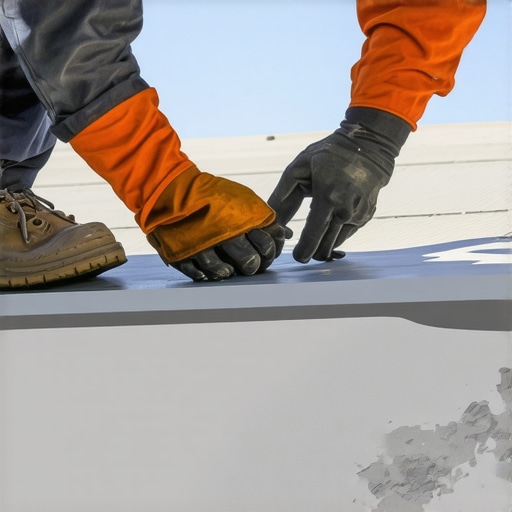
- The Pull: Take your pliers and firmly grasp an un-welded flap of the membrane. Pull vertically.
- The Evidence: If the membrane peels back with the ease of a Post-it note, you have a failure. You should see ‘stringing’—the adhesive stretching like melted mozzarella—and more importantly, you should see the top facer of the insulation board ripping off with the membrane. If the back of the TPO is clean and the insulation looks untouched, they ‘dry-fitted’ you.
If you see a clean separation, the installer likely didn’t wait for the ‘flash-off’ time. Bonding adhesive is a contact cement. You apply it to both the board and the membrane, wait for it to become tacky (the finger-knuckle test), and then mate them. If they mate it while it’s wet, the solvents get trapped and eat the foam. If they wait too long, it dries out. Both lead to a roof that’s just sitting there by gravity alone. You’ll often find that the specific TPO seam failure that most maintenance teams overlook starts with poor adhesion at the base of the wall.
The ‘Mist’ Scam: How Contractors Save $5,000 per Job
In the trade, we see guys using a 1/2-inch nap roller to apply adhesive so thin you can still see the print on the ISO board. A proper application should look like a solid, uniform coat of yellow or green (depending on the brand). When local roofers get lazy, they ‘strip’ the glue—putting a heavy bead every 12 inches and hoping for the best. This creates ‘air channels’ under the roof. During a summer heatwave, the air in those channels expands, creating ‘pillowing.’ If you see your roof looking like a quilt after a hot day, your adhesive is failing. You’re also likely missing the missing termination bar why your tpo wall flashings always fail first, which allows air to infiltrate under the membrane at the perimeter.
“All roof coverings shall be applied in accordance with the manufacturer’s installation instructions. Acceptance of the substrate is the responsibility of the installer.” – International Building Code (IBC) Section 1507.1
The Band-Aid vs. The Surgery
If you catch this during the install, stop the job. If you catch it after the fact, you’re in a world of hurt. A ‘shiner’ (a missed nail in a shingle roof) is an easy fix. A non-adhered TPO roof is a systemic failure. You can’t just inject glue under it; the solvents in the new glue will rarely bond correctly to the cured adhesive on the membrane. You are looking at a full ‘recover’ or a complete tear-off. This is why 7 commercial roofing costs that will surprise you in 2026 often stem from having to do the job twice because the first guy treated the bonding adhesive like it was gold-pressed platinum.
The Warranty Trap
Don’t let them tell you, ‘It’s okay, it’s under warranty.’ I’ve spent twenty years reading the fine print. Most manufacturer warranties only cover ‘material defects.’ If the installer didn’t use enough glue, that’s an ‘installation error,’ which is the first thing a manufacturer’s inspector will use to deny a claim. This is why most 2026 commercial roofing warranties are worthless if you don’t have a third-party inspection during the adhesive application. In the heat of the Southwest, you can’t afford to be wrong. Water is patient, but wind is violent. A poorly glued roof is a liability that will eventually land in your parking lot. Do the corner pull test. Spend the two minutes now, or spend $50,000 later. The choice is yours, but the physics of the desert won’t wait for you to decide. “