
I’ve spent the last quarter-century walking on baking-hot roofs, and if there’s one thing I’ve learned, it’s that a tile roof is a master of deception. From the curb, it looks like a fortress—solid, heavy, and immovable. But get up there after ten years of desert sun, and you’ll find it’s more like a house of cards waiting for the next monsoon to fold it. Most homeowners think their roof is fine until a five-pound piece of concrete slides off the eave and crushes the hood of their car. That’s not a roof failure; that’s a negligence bill. I’ve seen enough “handyman specials” to fill a landfill in Maricopa County, and frankly, I’m tired of seeing people get ripped off by local roofers who don’t know the difference between a head-lap and a hangover.
The Forensic Scene: A Roof That Felt Like a Sponge
Walking on that roof in the outskirts of Vegas felt like walking on a sponge. I knew exactly what I’d find underneath before I even pulled a single piece of clay. The homeowner swore the roof was “solid as a rock,” but as I stepped near the valley, the tiles groaned. When I bent down to perform what I call the Forensic Tap, the sound wasn’t the sharp clack of stone on stone; it was a dull, thudding thump. That thump is the sound of moisture-saturated rotting plywood and a dried-out felt underlayment that had long ago given up the ghost. I pulled back one tile and found the batten was so soft I could poke my finger through it. This is why you don’t wait for a leak in the living room to check your tiles.
“A roof is only as good as its flashing.” – Old Roofer’s Adage
The Physics of Failure: Why Tiles Go Rogue
In our climate, we deal with thermal shock. You’ve got a roof hitting 170°F by 2:00 PM, then dropping sixty degrees when the sun goes down. That constant expansion and contraction isn’t just hard on the materials; it’s a mechanical assault on the fasteners. Most concrete tiles are slipping off the roof batten because the nails—often cheap galvanized ones that have no business being in a high-quality install—have either rusted through or have backed out due to the constant vibration of the house. We also see capillary action. Water doesn’t just flow down; it crawls sideways. If your tiles aren’t seated perfectly, wind-driven rain gets sucked under the head-lap, sitting on that 30-lb felt until it turns into a mushy mess. This is why your tile roof underlayment might be failing early, even if the tiles look brand new from the ground.
The 30-Second Tap Test: A Homeowner’s Diagnostic
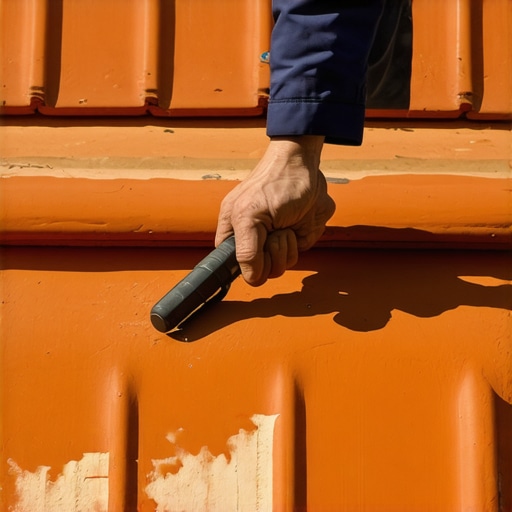
You don’t need a degree in structural engineering to find a loose tile. You need a rubber mallet or even the back of a heavy screwdriver. Start at the eaves—the most vulnerable part of the roof where wind uplift is highest. Tap the center of the tile gently. A secure tile will produce a high-pitched, solid ring. If you hear a rattle or a hollow “thwack,” that tile has disconnected from the batten or the nail has failed. This is the Mechanism Zooming you need: a loose tile creates a tiny gap. That gap allows high-velocity wind to get underneath, creating a pressure differential that literally sucks the tile off the roof. It’s Bernoulli’s principle in action, and it’s why tiles become projectiles during storm season. If you find more than five loose tiles in a single square (that’s a 100-square-foot area for the laypeople), you’ve got a systemic fastening failure, not just a minor repair. At that point, maintenance steps for a 50-year life become your only lifeline.
The Warranty Trap and Commercial Reality
I see this in commercial roofing too, especially with TPO roofing. People think because they have a “Lifetime Warranty,” they can just ignore the structure. Let me tell you, most warranties are worth less than the paper they’re printed on because they don’t cover “acts of God” or “improper maintenance.” If a tile flies off and hits your neighbor’s house, the manufacturer is going to point the finger at your installer, and your installer has probably already changed his business name three times this year. This is why most 2026 commercial roofing warranties are worthless. They are designed to protect the company, not your building. You need to be looking for the “shiners”—those missed nails that went straight into the attic space instead of the rafter—because those are the first places a leak will start when the underlayment finally cracks.
“The building envelope must be viewed as a system of integrated components, where the failure of one leads to the catastrophic degradation of the whole.” – NRCA Manual
The Surgery: Fixing It Right vs. The Band-Aid
When you find a loose tile, don’t let some guy with a ladder and a tube of caulk tell you he can “glue it down.” That’s a Band-Aid on a gunshot wound. Caulk is not a roofing material; it’s a temporary sealant. The correct fix involves removing the surrounding tiles, checking the integrity of the batten, replacing the secondary water resistance layer if it’s brittle, and re-securing the tile with stainless steel screws or wind clips. If your roofer isn’t talking about wind uplift ratings, fire them. If you’re looking at a quote that seems too good to be true, it probably is. Check 7 red flags in tile roof quotes before you sign anything. You’re paying for the physics of protection, not just the labor of throwing heavy shingles on a slope. If you ignore the cricket behind the chimney or the valley flashing gaps, you’re just counting down the days until the plywood turns back into sawdust. Don’t be the homeowner who waits for the ceiling to fall in; take 30 seconds and start tapping.
{“@context”:”https://schema.org”,”@type”:”HowTo”,”name”:”The 30-Second Tile Roof Tap Test”,”description”:”A diagnostic method for homeowners to identify loose or unfastened roof tiles before they become a hazard during storms.”,”step”:[{“@type”:”HowToStep”,”text”:”Secure a ladder properly to the eave of the house, ensuring you have a rubber mallet or heavy-handled screwdriver.”,”name”:”Preparation”},{“@type”:”HowToStep”,”text”:”Ascend to the roof edge. Do not walk on the tiles if possible; perform the test from the ladder for the perimeter tiles.”,”name”:”Accessing the Eaves”},{“@type”:”HowToStep”,”text”:”Gently tap the center of each tile. Listen for a sharp ‘clack’ (secure) versus a hollow ‘thud’ or rattle (loose).”,”name”:”The Tap Test”},{“@type”:”HowToStep”,”text”:”Mark any loose tiles with chalk for a professional roofer to inspect the batten and fastener integrity underneath.”,”name”:”Documentation”}],”totalTime”:”PT30S”}