
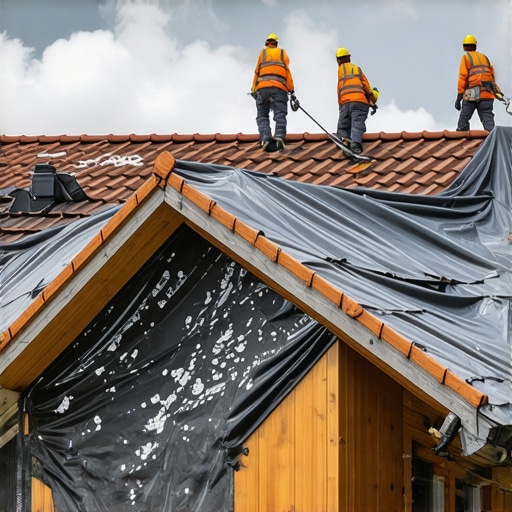
The Sound of the Sky Falling: Surviving the 2026 Hail Season
You hear it before you see it—the roar of a freight train composed of ice and gravel hitting your roof deck. When 2.5-inch hail stones hammer your property, the damage isn’t just cosmetic; it is a structural countdown. Walking on that roof felt like walking on a sponge during my last inspection. I knew exactly what I’d find underneath: fractured bitumen, pulverized granules, and a deck that was gasping for air. As a forensic roofer with twenty-five years in the trenches, I’ve seen homeowners lose their entire investment because they waited for a ‘free roof’ from a storm chaser instead of taking immediate mechanical action.
In the high-altitude heat of the Western Plains, 2026 has brought a specific brand of atmospheric violence. Hail doesn’t just ‘dent’ a shingle. It causes a localized compression that crushes the fiberglass matting. This creates a bruise where the protective granules are stripped away, exposing the asphalt to UV radiation. Within weeks, that sun-baked asphalt cracks, and capillary action begins to pull water sideways, defying gravity and bypassing your underlayment entirely. If you own a commercial property with TPO roofing, the stakes are even higher. A single puncture in a brittle, aged membrane can saturate the insulation board, turning your high-efficiency roof into a massive, heat-holding swamp.
“Water is the most patient architect of destruction. It only needs a microscopic path to ruin a structure.” – Forensic Engineering Axiom
1. The Immediate Tarping of Critical Valleys and Crickets
Your first move isn’t calling the adjuster; it’s stopping the bleed. The valley is the most vulnerable part of any residential system. When hail hits a valley, it often fractures the flashing or the weaving of the shingles. You need to deploy a heavy-duty reinforced tarp from the ridge down to the eave. Don’t just throw rocks on it. You need to use ‘furring strips’—thin wood lath—to nail the tarp down so the wind doesn’t turn it into a sail. If you have a chimney, check the cricket—that small peaked structure behind it. If the cricket is clogged with hail-stripped leaves and ice, water will back up under the counter-flashing and pour into your living room. Professional local roofers will tell you that a tarp is a ‘Band-Aid,’ but in 2026, a well-secured Band-Aid can save you $50,000 in interior mold remediation.
2. Emergency Sealant for Tile Roof Fractures
If you have a tile roof, do not assume because it’s ‘stone’ that it’s safe. Hail doesn’t just crack tiles; it creates star-shaped fractures that are invisible from the ground. Water enters these cracks and begins the freeze-thaw cycle, or worse, washes out the head-lap where the tiles overlap. For an emergency fix, you aren’t replacing tiles yet—you are using a high-grade solar-stable mastic or specialized roofing cement to bridge the gaps. This stops the hydrostatic pressure from forcing water under the tile where it can rot the battens. You can find more on this in our guide to tile roof maintenance and leak stops. Remember, a single cracked tile can lead to a ‘shiner’—a nail that missed the rafter and is now a direct conduit for water into your attic.
3. Commercial TPO Membrane Patching and Weld Inspection
For those managing commercial assets, TPO roofing presents a unique challenge after a storm. Hail can create ‘micro-fissures’ in the top ply of the membrane. You need to perform a ‘probe test.’ Take a specialized rounded tool and run it along the seams. If the probe sinks in, the weld has failed due to the vibration and impact of the hail. The emergency fix here is a ‘peel-and-stick’ TPO patch kit. You must clean the area with a weathered membrane cleaner first, or the patch will slide off like butter on a hot pan. If you ignore these punctures, the moisture will migrate through the cover board, leading to thermal bridging where your expensive AC is sucked out through the wet insulation. This is one of the many TPO roofing mistakes that drain budgets after a storm.
4. Assessing the ‘Functional Damage’ for Insurance Defense
The biggest fix after a 2026 storm isn’t physical—it’s tactical. You need a forensic assessment to prove ‘functional damage’ to your adjuster. A ‘storm chaser’ will point at a dent and scream ‘replacement.’ An adjuster will call it ‘cosmetic.’ You need a veteran roofer who understands the physics of failure. We look for ‘granule displacement’ and ‘fractured matting.’ If the hail has compromised the shedding capacity of the shingle, it is functional damage.
“A roof is only as good as its flashing, and its warranty is only as good as the contractor’s reputation.” – Old Roofer’s Adage
Don’t get caught in the trap of the ‘free roof’ scam where the contractor eats your deductible; that is insurance fraud and usually leads to a ‘tail-light warranty’—they’re gone as soon as you see their tail-lights. Check for signs of inspection failure before you sign any contingency agreements.
The Cost of Hesitation
In the 140°F heat of a post-storm summer, a bruised roof decays at triple the normal rate. The bitumen oils migrate out, the shingles become brittle, and the next ‘minor’ rainstorm becomes a catastrophic flood. Whether you are dealing with residential asphalt or complex commercial roofing, the clock started the second the hail stopped falling. Get a real pro, get a tarp on the critical failures, and don’t let a ‘trunk slammer’ turn your biggest asset into a forensic crime scene.
Comments are closed.