
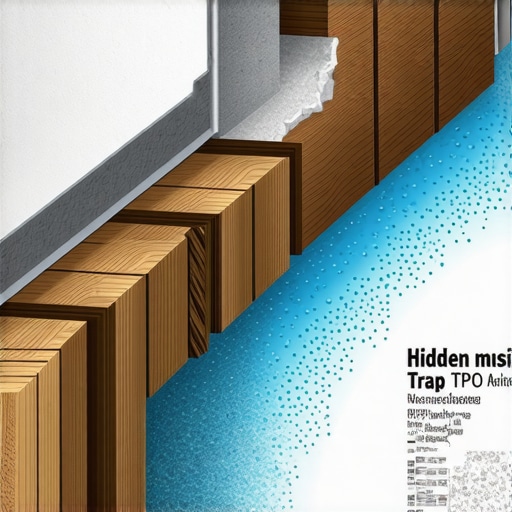
The problem is not always the new TPO. It is what gets sealed under it.
A white TPO membrane can be a good commercial roof system when the substrate below it is dry, sound, and properly prepared. The trouble starts when a new membrane is installed over an old roof that already has wet insulation, poor drainage, loose fasteners, or a deck that has started to rust or soften.
From an engineering standpoint, a roof recover is not just a cost decision. It changes the way heat, vapor, fasteners, and trapped water behave inside the roof assembly. If the old roof is not opened and tested in the right places, the new TPO can trap moisture that was already there.
That is why the first question should not be, “Can we install TPO over the existing roof?” The better question is, “What condition is the existing assembly in, and what evidence do we have?”
What a moisture trap looks like under a TPO recover
A typical failure starts with a roof that has had small leaks for years. The interior may show only a few stained ceiling tiles, but water can spread laterally through insulation boards. When a new TPO membrane is installed over that assembly, the top surface is now tighter and less forgiving.
The moisture below the membrane can move as vapor when the roof heats up. At night, or during cold weather, that vapor can condense again inside the insulation layer or near the deck. On a steel deck, that often means corrosion around fastener lines and laps. On a wood deck, it can mean softening, delamination, or rot.
This does not prove that every recover fails. Many do not. But a recover over wet materials is a different risk category than a recover over a dry, stable roof. GAF’s current TPO/PVC mechanically attached roofing manual states that existing roofing materials containing moisture should be removed and replaced, and that decking condition should be confirmed by inspection and fastener pull-out testing where applicable. That is a practical requirement, not a sales preference.
The inspection order I would want before approving a recover
Before a commercial owner accepts a lower recover bid, I would want the roof checked in this order:
1. Confirm how many roof systems are already in place
A recover is not always allowed. The International Building Code limits when new roof coverings can be installed over existing coverings, and local code may require tear-off in specific conditions. A contractor should verify the existing roof count before pricing the job as a simple layover.
If nobody has made test cuts, nobody truly knows the roof build-up. A roof may look like one system from the surface and still have multiple membranes, old cover board, saturated insulation, or abandoned repairs underneath.
2. Map the drainage before talking about membrane
TPO does not solve standing water by itself. Before choosing membrane thickness or attachment method, the roof should be walked after rain or checked for ponding stains, blocked drains, low areas near HVAC curbs, and missing or undersized crickets.
If water sits at the same drain line every storm, adding a new membrane over the same slope problem only protects the appearance for a while. It does not correct the load, dirt buildup, algae staining, or repeated stress around seams and penetrations.
3. Use non-destructive moisture testing, then verify with core cuts
Infrared scanning, nuclear testing, or impedance testing can help locate suspicious areas, but they should not be treated as perfect proof by themselves. The sensible process is to scan first, mark suspect zones, then make core cuts to confirm what is actually wet and how deep the moisture goes.
NRCA guidance has long recommended using non-destructive moisture surveys to locate wet insulation, while confirming findings with test cuts or destructive testing. That combination matters because surface readings can be affected by roof type, insulation type, time of day, and weather conditions.
4. Check the deck, not only the insulation
Wet insulation is serious, but the deck tells you whether the building structure has already been affected. On steel decks, I want to know whether corrosion is surface-level or whether fastener pull-out resistance has been reduced. On wood decks, I want to know whether the deck is still firm enough to hold attachment and resist wind uplift.
A soft or rusted deck changes the scope. At that point, the issue is no longer just TPO roofing. It becomes structural preparation, replacement quantities, safety, and warranty eligibility.
Why a low recover bid can become the most expensive option
A cheaper bid often leaves out the work that proves the roof is safe to cover. The omitted items usually look small on paper: moisture scan, core cuts, deck inspection, pull tests, tapered insulation at ponding areas, cricket installation, and removal of wet sections.
Those items are not decorative. They answer the questions that determine whether the new roof has a stable base. If a bid is far lower than the others, ask where these tasks are shown in the scope. If they are not listed, the price may be low because the risk has been moved from the contractor’s estimate to the owner’s building.
This is also where warranty assumptions become dangerous. A manufacturer may warrant the membrane, but that does not mean the manufacturer accepts responsibility for wet insulation, deteriorated decking, trapped moisture, or poor existing conditions. That is one reason I would read most 2026 commercial roofing warranties are worthless before treating a warranty term as real protection.
Fasteners, seams, and freeze-thaw movement are part of the same problem
Moisture trapped below TPO does not stay politely in one layer. It can affect fastener plates, insulation facer, cover board, and the deck. When temperatures move sharply, the roof assembly moves too. Wet materials expand, contract, and lose strength differently from dry materials.
That is why a seam issue is not always just a welding issue. A seam can fail because the membrane was poorly welded, but it can also be stressed by movement below it, loose attachment, ponding water, or wet insulation. This is closely related to TPO seams pop after the first freeze, especially where the original installation did not control moisture and movement at the same time.
The same logic applies to penetrations and curbs. If water collects behind a curb because there is no proper cricket, the membrane takes repeated stress at the same location. If that area also has wet insulation below, the repair is no longer just a bead of sealant around the flashing.
Signs that the deck may already be affected
A property manager should not wait for water to drip into the building before asking for a roof assessment. Look for warning signs that suggest movement or loss of attachment:
- Areas that feel soft, springy, or uneven underfoot.
- TPO that flutters or billows more than surrounding areas during wind.
- Rust staining below a steel deck or around fastener lines.
- Ceiling stains that appear away from the obvious roof penetration.
- Ponding water that remains after the rest of the roof has dried.
- Repeated seam repairs in the same roof zone.
- Interior humidity sources below the roof, such as kitchens, laundries, production areas, or unvented spaces.
None of these signs alone proves deck failure. They are reasons to stop guessing and test the assembly. A few well-placed core cuts can prevent a much larger surprise after the old roof is already buried.
What to ask before signing a TPO recover proposal
Before approving a recover, ask the roofer to answer these questions in writing:
- How many existing roof systems are currently on the building?
- Where were the core cuts taken, and what layers were found?
- Was a moisture survey performed, and how were suspect areas confirmed?
- What wet insulation or damaged materials will be removed before the new TPO is installed?
- How will ponding areas, drains, scuppers, and crickets be handled?
- Will fastener pull-out testing be performed where mechanical attachment is proposed?
- What deck repairs are included, and what unit price applies if more damaged deck is found?
- Does the manufacturer accept the proposed recover assembly over the existing materials?
If the answer is “we will know once we start,” the contract should still define how discoveries will be handled. Deck replacement is one of the items that can change a reroof budget quickly, which is why it belongs in the discussion before the job starts. It is also one of the 7 commercial roofing costs that will surprise you in 2026.
Where local roofers often miss the risk
Some local roofers price a recover as if the old roof is only a surface to cover. That is the wrong way to evaluate commercial roofing. The old assembly is part of the new system unless it is removed. Its moisture, slope, attachment, insulation type, and deck condition all carry forward.
This is different from a simple shingle replacement or a tile roof repair where the visible surface often tells more of the story. On a low-slope commercial roof, the important damage may be buried under membrane, insulation, and cover board. That is why a clean white surface after installation does not prove the job was technically sound.
A contractor does not need to use dramatic language to prove competence. The proposal should show the process: survey, core, confirm, remove wet areas, repair deck, correct drainage, install approved assembly, document the work. If that sequence is missing, the building owner is being asked to accept risk without evidence.
Do this before approving a new TPO roof over an old one
Start with a written existing-condition assessment. Require moisture testing, core cuts, roof-count verification, drainage review, and deck evaluation before the recover scope is finalized. Any wet insulation, deteriorated decking, or ponding condition should be priced as part of the decision, not treated as an afterthought.
If the roof already has suspicious soft spots, repeated seam repairs, ponding water, or unexplained ceiling stains, do not approve a simple layover. Open the roof in the right places first. The cheapest TPO bid is only cheaper if the assembly underneath is dry, stable, and able to hold the new system.
For a deeper list of related failure points, review 5 hidden TPO roofing faults killing your 2026 budget before comparing proposals.